
Clinician · Site Aran cohort_q4 → 287 patients
POPIAHIPAAGDPR
a_4f2a1b…
LumkoMDX is a federated data infrastructure for healthcare. Identity stays at the source; queries travel; insight returns. Each module works alone, but the whole is what makes sovereignty possible.
Every healthcare data system in existence asks the same question: how much identity exposure are we willing to accept in exchange for utility?
Aggregation platforms answer it by copying data into central warehouses. De-identification frameworks answer it by stripping fields and hoping. Both treat sovereignty as a policy enforced by humans — and humans, by definition, can be wrong, hacked, or coerced.
LumkoMDX answers it differently. Identity exposure is made structurally impossible by the Three-Boundary Model below. Patient records never leave the source system. Queries are federated. Only aggregated, consent-validated insight ever moves.
Cryptographic pseudonymisation happens before any field leaves the source EMR. The federation layer never sees identifiers.
A query plan goes out; an aggregate comes back. Records, photos, free-text — all stay where they were created.
Every query checks consent at the moment it runs — not at sign-up. Revocations propagate in real time.
That is what "sovereign by design" means. Not a marketing line — a property of the system.
Every module earns its place by doing one job in this flow. The architecture makes it the only path possible.
A clinician, researcher or executive asks a question — in plain language or as a structured cohort filter.
Insight Studio compiles the question into a federated query plan. No identity touches this layer.
The Federation Layer fans the plan out to participating sites. Each site executes against its own local data.
Only sums, counts, and consented summaries return. Audit & Consent signs every step before, during, after.
Each module solves a specific problem. The architecture is what makes them sovereign together.
Tour the platform
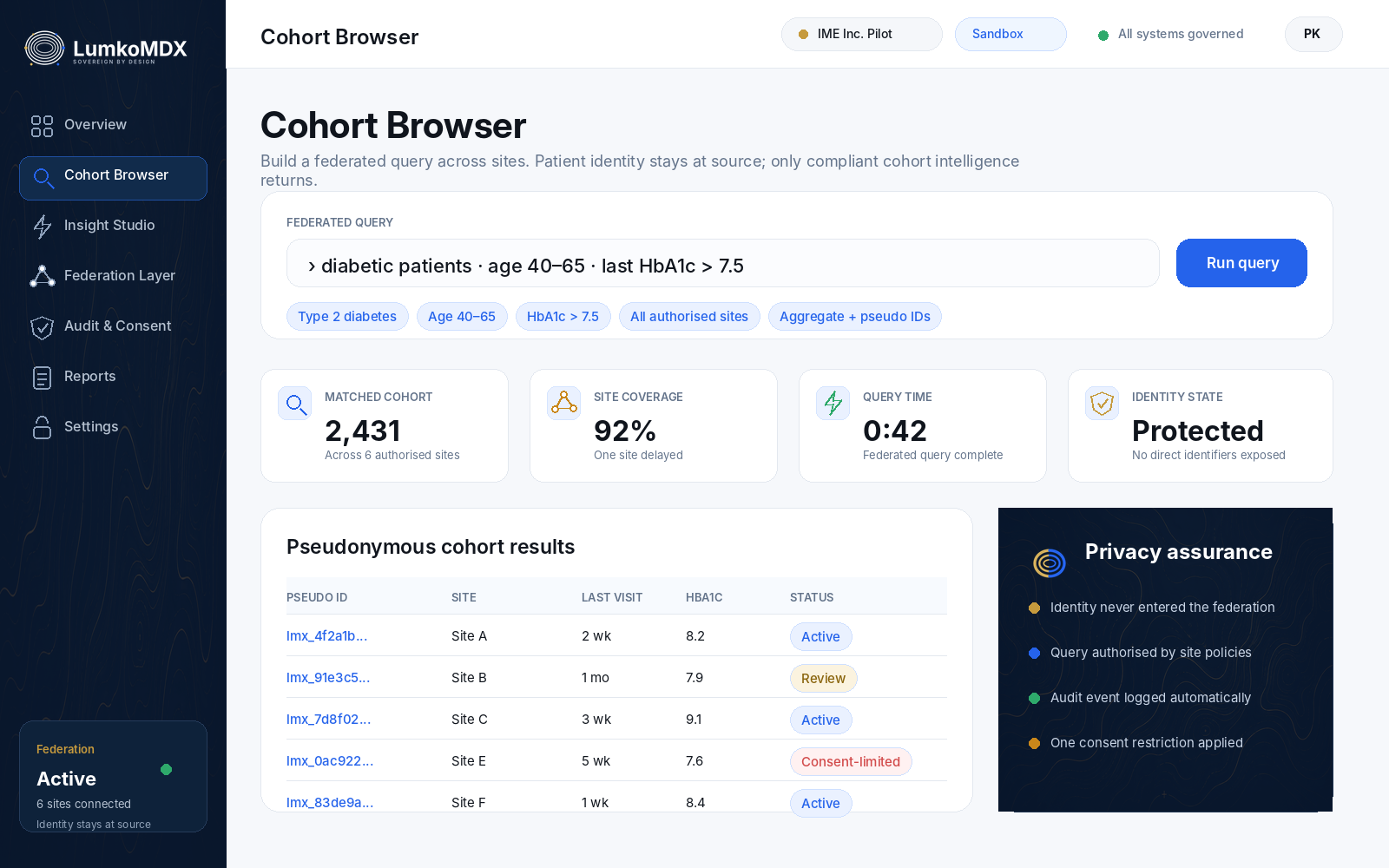
Build patient cohorts across federated sites
Cohort Browser
A visual environment for building cohorts across federated sites. Every filter, every join, every count is computed at source. Results return as pseudonymous IDs.
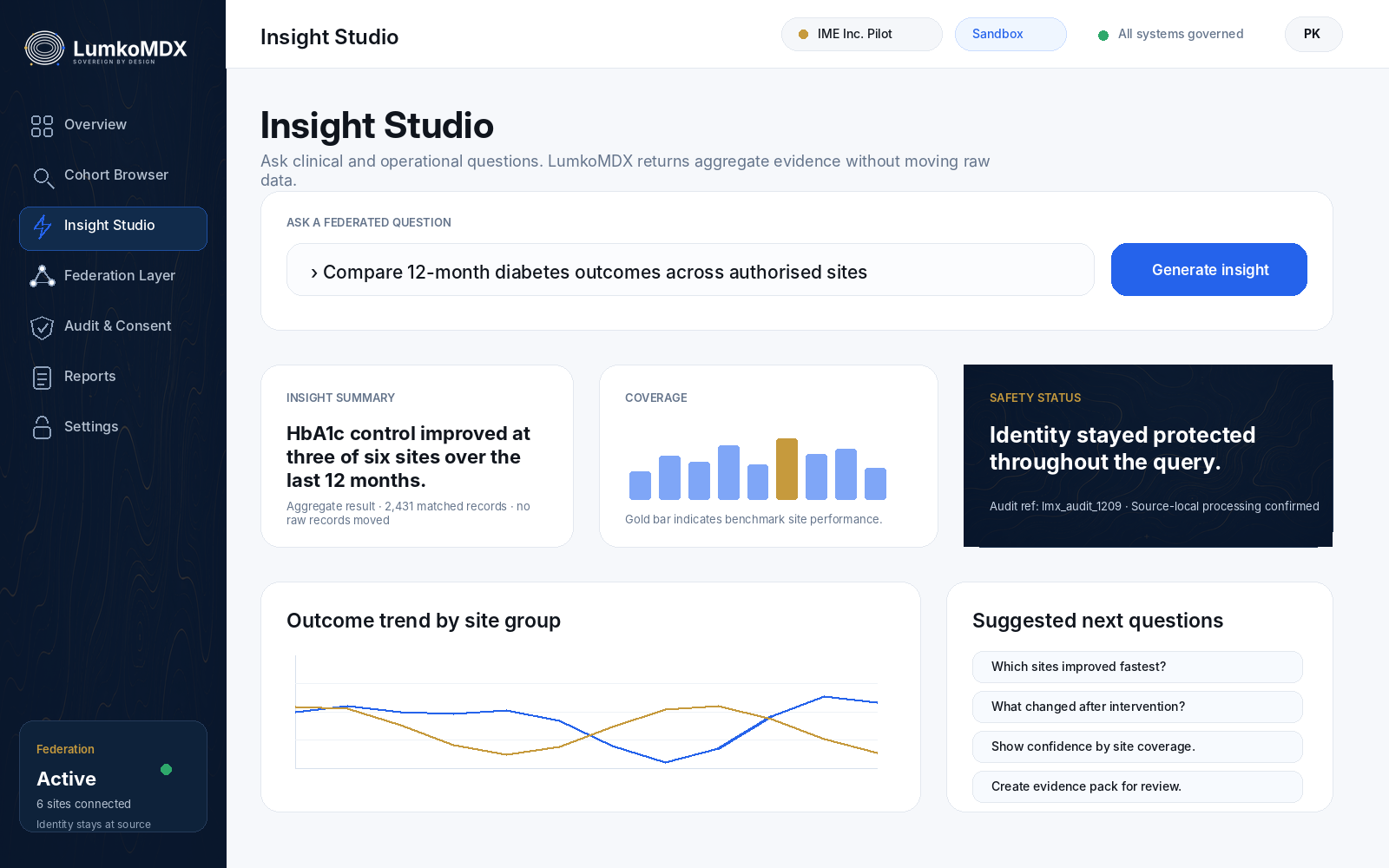
Insight Studio
A reasoning surface for clinical and operational analysis. Translates plain language into federated queries — and translates federated results back into plain answers, with full citation.
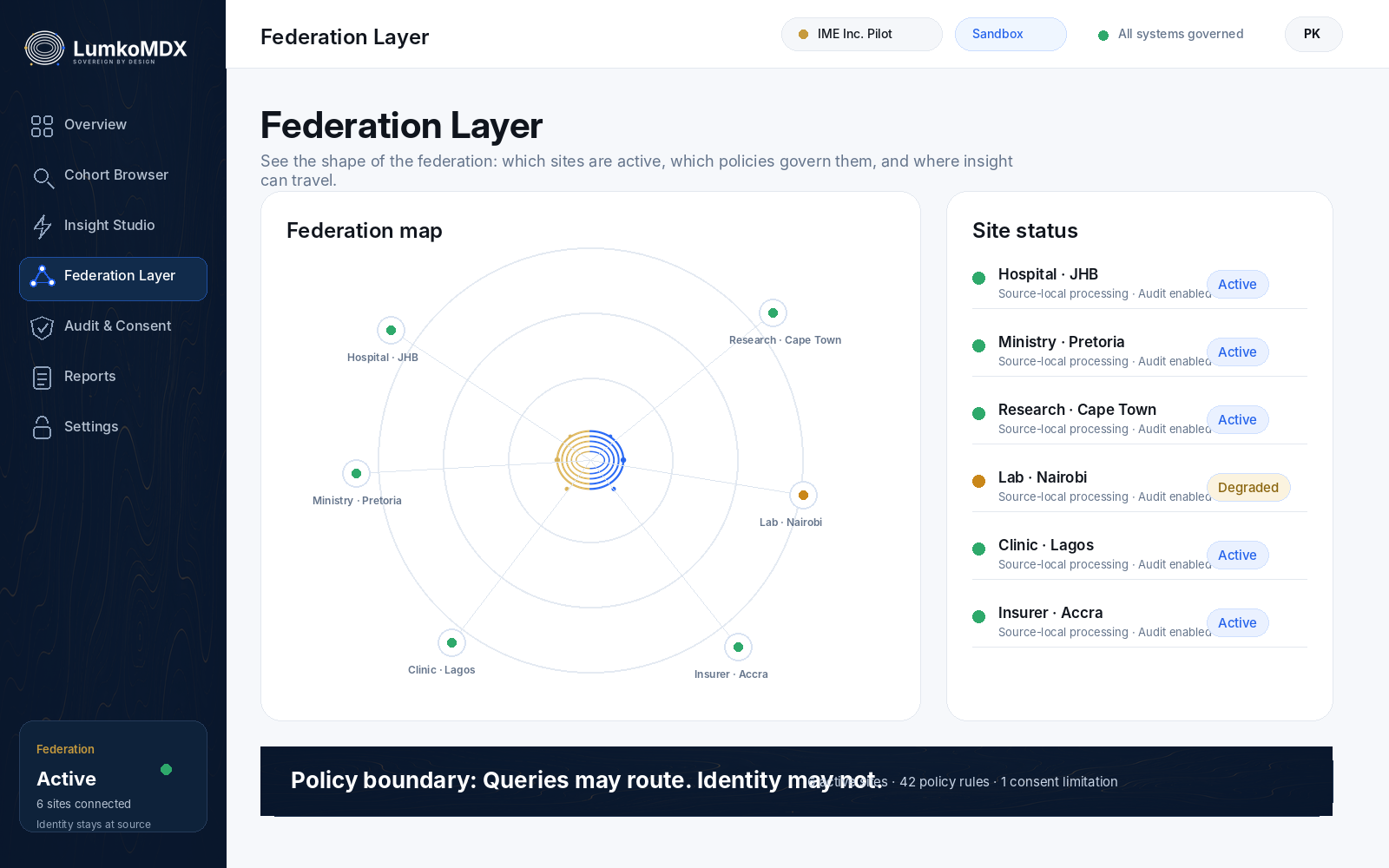
Federation Layer
The protocol that makes the rest possible. A secure substrate that routes queries to participating sites, executes them locally, and returns aggregated results — never raw records.
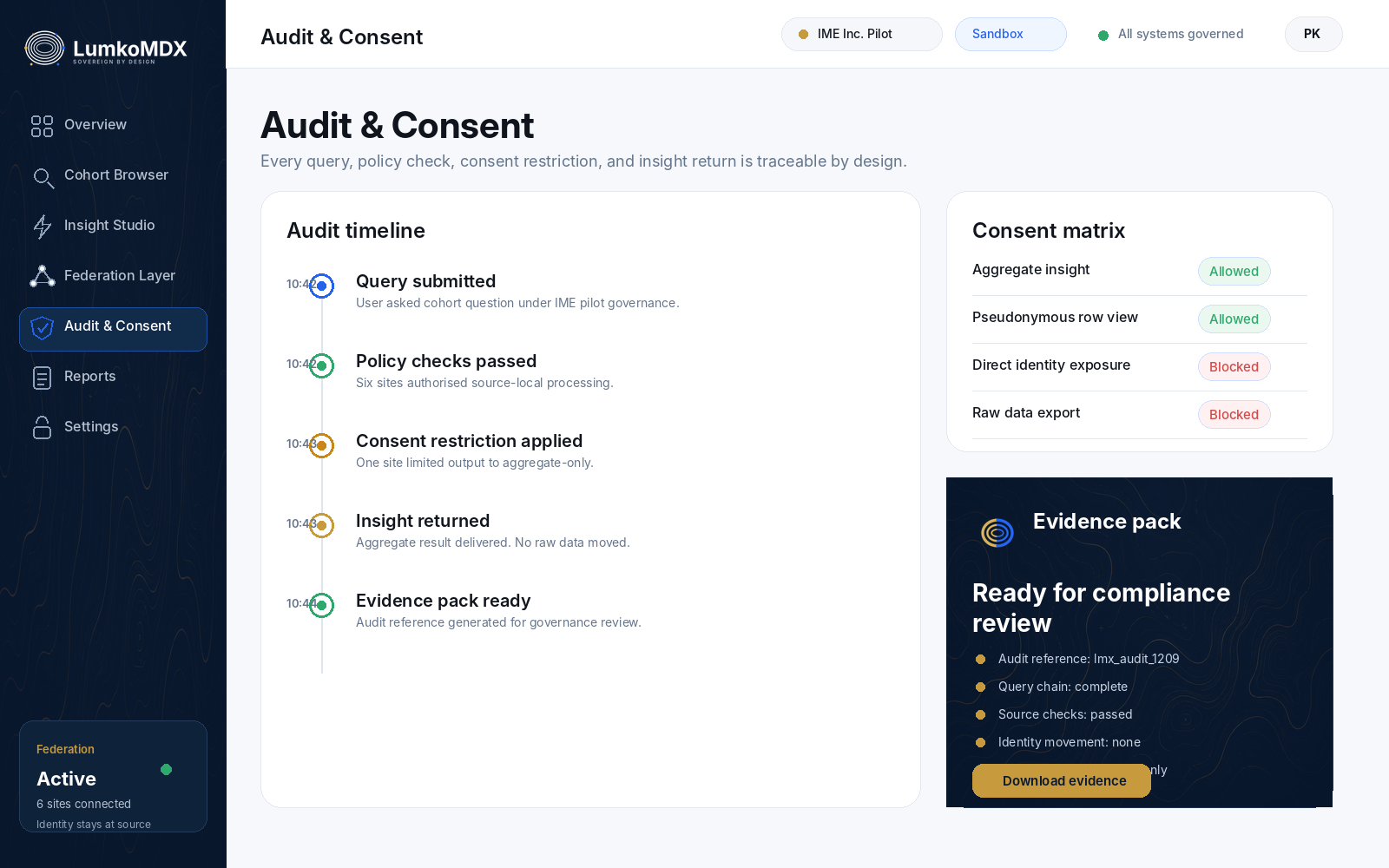
Audit & Consent
A continuous record of who asked what, when, and under what authority. Consent is verified at the moment of every query, not at sign-up. Compliance is the byproduct, not the goal.
Other approaches solve parts of this. The LumkoMDX difference is the system: sovereignty, federation, and execution-time consent together — by architecture, not policy.
| Capability | Centralised data lakes |
De-identification pipelines |
Federated research networks |
LumkoMDX |
|---|---|---|---|---|
| Identity stays at source | × | ◐ | ◐ | ● |
| No central data copy | × | × | ● | ● |
| Re-identification structurally impossible | × | × | ◐ | ● |
| Federated query at runtime | × | × | ● | ● |
| Consent verified at execution | × | × | ◐ | ● |
| Population-scale analytics | ● | ● | ● | ● |
● FULL ◐ PARTIAL × NOT BY DEFAULT
We'd rather show you than tell you. Walk through a working environment with real federated data.